










Standard Envelope Sizes: The Complete Guide (Inches, cm & mm)

Standard Envelope Sizes: The Complete Guide (Inches, cm & mm)
By Ben Parker, Founder & Sales Director, Packaging Box LLC · Last updated June 30, 2026
Quick Answer
A standard envelope size is one of a fixed set of postal-approved dimensions used for mailing letters, invitations, and documents. In the US, the most common is the #10 envelope (4.125″ x 9.5″), used for business letters and invoices. Internationally, the DL envelope (110mm x 220mm) plays the same role. Card and invitation mail typically uses A2 (4.375″ x 5.75″) in the US or C6 (114mm x 162mm) internationally.
Envelope sizes fall into a handful of families — US commercial, A-series, C-series, and DL — each built around a matching paper or card size. Picking the right one comes down to what you’re mailing, whether you’re sending domestically or internationally, and what postal automation rules apply.
Why Standard Envelope Sizes Matter
An envelope that’s the wrong size costs you twice: once in postage, once in presentation. Oversized envelopes can bump a mail piece from letter-rate to flat-rate postage. Undersized ones force extra folds that make a document look sloppy or crack a fold line on cardstock invitations.
Standard sizes exist because postal services, printers, and paper mills all build around the same handful of dimensions. A #10 envelope fits a standard 8.5″ x 11″ letter folded in thirds because that’s the measurement every US printer, envelope manufacturer, and mail-sorting machine is calibrated for. Step outside those dimensions and you lose that compatibility — higher costs, slower processing, and a piece of mail that just looks off.
For businesses ordering envelopes at volume — invoices, direct mail, event invitations, product mailers — knowing the standard sizes isn’t optional. It’s the first decision that determines postage class, print layout, and how professional the finished piece looks in someone’s hand.
Standard Envelope Size Chart: Every Size at a Glance
Here’s every commonly used envelope size in one place, in inches, centimeters, and millimeters.
| Envelope | Inches | Centimeters | Millimeters | Typical Use |
|---|---|---|---|---|
| #6¾ | 3.625″ x 6.5″ | 9.2 x 16.5 cm | 92 x 165 mm | Small business mail, checks, coupons |
| #9 | 3.875″ x 8.875″ | 9.8 x 22.5 cm | 98 x 225 mm | Reply envelopes (fits inside a #10) |
| #10 | 4.125″ x 9.5″ | 10.5 x 24.1 cm | 105 x 241 mm | Standard business letters, invoices |
| Monarch (#7¾) | 3.875″ x 7.5″ | 9.8 x 19.1 cm | 98 x 190 mm | Personal/executive correspondence |
| Legal (9 x 14) | 9″ x 14″ | 22.9 x 35.6 cm | 229 x 356 mm | Legal documents, unfolded letter paper |
| A2 | 4.375″ x 5.75″ | 11.1 x 14.6 cm | 111 x 146 mm | Thank-you notes, RSVP cards |
| A5 | 4.375″ x 5.75″* | — | — | *Note: US “A5” naming varies by supplier — confirm insert size before ordering |
| A6 | 4.75″ x 6.5″ | 12.1 x 16.5 cm | 121 x 165 mm | Greeting cards, postcards |
| A7 | 5.25″ x 7.25″ | 13.3 x 18.4 cm | 133 x 184 mm | Wedding invitations, 5×7 cards |
| A9 | 5.75″ x 8.75″ | 14.6 x 22.2 cm | 146 x 222 mm | Oversized invitations, formal announcements |
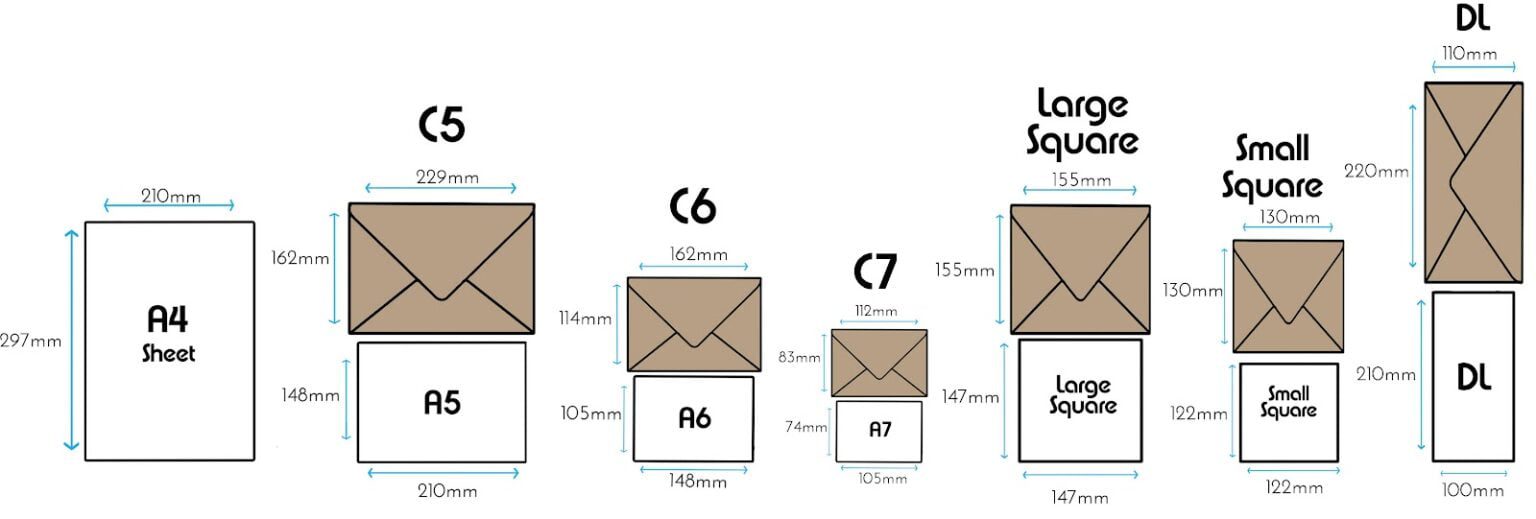
| DL | 4.33″ x 8.66″ | 11 x 22 cm | 110 x 220 mm | A4 folded in thirds — the international #10 |
| C4 | 9.02″ x 12.76″ | 22.9 x 32.4 cm | 229 x 324 mm | Unfolded A4 documents |
| C5 | 6.38″ x 9.02″ | 16.2 x 22.9 cm | 162 x 229 mm | A4 folded in half, A5 flat |
| C6 | 4.49″ x 6.38″ | 11.4 x 16.2 cm | 114 x 162 mm | A4 folded in quarters, cards |
| C7 | 3.19″ x 4.49″ | 8.1 x 11.4 cm | 81 x 114 mm | Small notes, coin envelopes |
| 9 x 12 (Catalog) | 9″ x 12″ | 22.9 x 30.5 cm | 229 x 305 mm | Unfolded letter-size documents, presentation kits |
| Square | 5″ x 5″ / 6″ x 6″ | 12.7 x 12.7 cm / 15.2 x 15.2 cm | — | Premium invitations, greeting cards |
Two things worth knowing before you order:
- A-series and C-series aren’t the same system. A-series (A2, A6, A7, A9) is the US naming convention for card and invitation envelopes. C-series (C4, C5, C6, C7) is the ISO 216 international standard, sized to match A4, A5, and A6 paper. They look similar on paper but come from different systems — don’t substitute one for the other without checking your insert size.
- DL is not the same as US A-series. DL (short for “Dimension Lengthwise”) is the international equivalent of a #10 — built to hold an A4 sheet folded in thirds. If you’re mailing internationally, DL is almost always the right call for a standard letter.
US Commercial & Business Envelope Sizes
#10 Envelope Dimensions
The #10 envelope measures 4.125″ x 9.5″ and is the default size for US business correspondence — letters, invoices, statements, and general office mail. It holds a standard 8.5″ x 11″ sheet folded in thirds. If you only stock one envelope size for business mail, this is the one.
#9 Envelope Dimensions
At 3.875″ x 8.875″, the #9 is slightly smaller than a #10 and is built to slide inside one — it’s the standard size for pre-paid reply envelopes and business reply mail.
#6¾ Envelope Dimensions
The #6¾ measures 3.625″ x 6.5″. It’s compact — used for personal checks, gift cards, coupons, and smaller enclosures where a full #10 would be overkill.
Legal Envelope Size
Legal envelopes measure 9″ x 14″ and are built to hold legal-size paper (8.5″ x 14″) without folding. Law firms, title companies, and any business mailing unfolded legal documents typically standardize on this size.
Letter Envelope Dimensions
“Letter envelope” is a general term most often referring to the #10, since it’s built specifically to carry a standard letter-size (8.5″ x 11″) sheet folded in thirds. If someone asks for a “regular” or “normal” envelope in the US, the #10 is almost always what they mean.
A-Series Envelope Sizes (Cards & Invitations)
The A-series is built around standard card sizes, which makes it the default for anything social: invitations, greeting cards, announcements.
A2 Envelope Size
A2 measures 4.375″ x 5.75″ and holds a 4.25″ x 5.5″ card — the standard size for thank-you notes, RSVP cards, and small flat announcements.
A6 Envelope Dimensions
A6 measures 4.75″ x 6.5″, sized for a 4.5″ x 6.25″ card. It’s the go-to for general greeting cards and folded note cards.
A7 Envelope Dimensions
A7 measures 5.25″ x 7.25″ and is built for a 5″ x 7″ card — the standard size for wedding invitations, save-the-dates, and formal event announcements.
A9 Envelope Size
A9 measures 5.75″ x 8.75″, used for oversized invitations and multi-piece formal announcements that don’t fit in an A7.
International Envelope Sizes: DL & C-Series
If you’re mailing outside the US, or working with A4-based paper sizes, the ISO 216 system (DL and C-series) is the standard — not the US commercial sizes above.
DL Envelope Size
DL measures 110mm x 220mm (4.33″ x 8.66″). It’s built to hold an A4 sheet folded in thirds, making it the international equivalent of a #10 — the default size for standard business letters outside the US.
DL Envelope Size in Inches
Converted, a DL envelope is 4.33″ x 8.66″. This is the figure to use if you’re specifying a DL envelope to a US-based printer that works in inches rather than millimeters.
C4 Envelope Size
C4 measures 229mm x 324mm (9.02″ x 12.76″). It holds an A4 sheet completely flat, unfolded — used for contracts, certificates, and any document where creasing isn’t acceptable.
C5 Envelope Size
C5 measures 162mm x 229mm (6.38″ x 9.02″). It fits an A4 sheet folded in half, or an A5 sheet flat — a common size for brochures and product announcements.
C6 Envelope Measurements
C6 measures 114mm x 162mm (4.49″ x 6.38″). It holds an A4 sheet folded into quarters, or a C6-sized greeting card — a frequent choice for postcards and small mailers.
C7 Envelope Size
C7 measures 81mm x 114mm (3.19″ x 4.49″) — a small format used for compliment slips, coin envelopes, and short notes.
Specialty Envelope Types
Catalog envelopes (9″ x 12″ and larger) open at the short end and are built to hold documents flat, without folding — common for presentation kits, real estate listings, and photography proofs.
Square envelopes (5″ x 5″, 6″ x 6″) are popular for premium invitations and greeting cards, though it’s worth knowing that square envelopes fall outside standard USPS machinable dimensions (see below) and can incur a surcharge.
Padded and shipping mailers protect small physical products rather than paper — used heavily by ecommerce sellers shipping jewelry, cosmetics, electronics accessories, and other lightweight items that need cushioning rather than a rigid box.
How to Choose the Right Envelope Size
Work through these in order:
- Match the envelope to your paper or card size first, not the other way around. A folded letter needs a #10 or DL; a flat A4 document needs a C4; a 5×7 card needs an A7.
- Check your postage class. In the US, envelopes at or under 6.125″ x 11.5″ x 0.25″ thick and 3.5 oz qualify as letter-rate mail. Anything larger is classified as a flat, which costs more.
- Check aspect ratio for automation. USPS requires a length-to-height ratio between 1.3 and 2.5 for machinable letters. Square envelopes (ratio of 1.0) fall outside this range and are handled manually, which can mean extra fees.
- Confirm domestic vs. international. US commercial and A-series sizes are standard domestically; DL and C-series are the norm internationally and for A4-based paper.
- Factor in your use case. Business mail defaults to #10/DL. Invitations default to A7/C6. Legal documents default to legal envelopes or C4 if they need to stay flat.
USPS Envelope Size Requirements
Before ordering in bulk, it’s worth knowing the rules USPS applies to standard mail:
- Minimum size: 3.5″ high x 5″ long x 0.007″ thick — anything smaller isn’t accepted for mailing.
- Maximum letter-rate size: 6.125″ high x 11.5″ long x 0.25″ thick, up to 3.5 oz. Beyond this, the piece is rated as a flat at a higher cost.
- Aspect ratio: length divided by height must fall between 1.3 and 2.5 to qualify for machinable, automated processing.
- Shape and construction: rectangular with four square corners, uniformly flexible, no clasps, strings, or buttons.
Envelopes that clear all four qualify for the standard machinable letter rate — the cheapest, fastest processing tier USPS offers.
Envelope Sizes by Use Case
Standard business mail: #10 (US) or DL (international) — the default for letters, invoices, and statements.
Wedding invitations: A7 in the US, C6 internationally — sized to match a 5×7 card or A6 invitation.
Legal documents: Legal (9″ x 14″) to fit legal paper folded once, or C4 if the document needs to stay completely flat.
Direct mail marketing: #10 or 6″ x 9″ catalog envelopes, depending on whether the piece is folded or flat.
Greeting cards: A2 or A6 in the US, C6 internationally.
Ecommerce and small-product mailers: Padded mailers sized to the product — jewelry and cosmetics typically ship in 6″ x 9″ padded envelopes.
Envelope Sizes in Inches vs. Centimeters: Quick Reference
Because US commercial and A-series sizes are measured in inches while DL and C-series are measured in millimeters, conversions come up constantly when comparing systems. A few of the most-searched:
- Standard #10 envelope: 4.125″ x 9.5″ = 10.5 cm x 24.1 cm
- DL envelope: 4.33″ x 8.66″ = 11 cm x 22 cm
- A2 envelope: 4.375″ x 5.75″ = 11.1 cm x 14.6 cm
- C4 envelope: 9.02″ x 12.76″ = 22.9 cm x 32.4 cm
- C6 envelope: 4.49″ x 6.38″ = 11.4 cm x 16.2 cm
The full chart above has every size in inches, centimeters, and millimeters side by side.
Frequently Asked Questions
What is the standard envelope size? In the US, the standard envelope size is the #10 (4.125″ x 9.5″), used for business letters and invoices. Internationally, the equivalent standard is the DL envelope (110mm x 220mm).
What size is a standard business envelope? A standard business envelope is a #10, measuring 4.125″ x 9.5″, built to hold a letter-size sheet folded in thirds.
What is the standard envelope size in cm? The #10 envelope, the US standard, measures 10.5 cm x 24.1 cm. The international standard, DL, measures 11 cm x 22 cm.
What size is a DL envelope? A DL envelope measures 110mm x 220mm, or 4.33″ x 8.66″ in inches. It’s built to hold an A4 sheet folded into thirds.
What are the dimensions of a #10 envelope? A #10 envelope measures 4.125″ x 9.5″ (105mm x 241mm).
What is a C6 envelope size? A C6 envelope measures 114mm x 162mm (4.49″ x 6.38″), sized to hold an A4 sheet folded into quarters or a small greeting card.
What size is a C4 envelope? A C4 envelope measures 229mm x 324mm (9.02″ x 12.76″), large enough to hold an A4 sheet flat without folding.
What size is an A5 envelope? “A5 envelope” sizing varies by supplier — some use it to mean an envelope that holds an A5 sheet (closer to a C5, 162mm x 229mm), others use it as a US card-envelope size. Confirm the insert dimensions with your supplier before ordering to avoid a mismatch.
What is a legal size envelope? A legal envelope measures 9″ x 14″, built to hold legal-size paper (8.5″ x 14″) without folding.
How big is a standard envelope? For US business mail, “standard” means a #10 at 4.125″ x 9.5″. For invitations and cards, “standard” more often means an A2 (4.375″ x 5.75″) or A7 (5.25″ x 7.25″).
What size is a normal/regular envelope? “Normal” or “regular” envelope almost always refers to the #10 in the US — the standard size for everyday letters and business mail.
Custom Envelope Printing at Packaging Box
Once you know the size you need, the next decision is material, print, and finish. Packaging Box LLC prints custom envelopes across the full range covered above — #10 and #9 for business correspondence, A2 and A7 for invitations, DL and C4 for international mail, and padded mailers for ecommerce shipping. We work with businesses across all 50 states, from small studios ordering short runs of branded A7 invitation envelopes to national companies running high-volume #10 business mail programs, matching material, print method, and turnaround to what the order actually needs.
For a size not covered here, or a custom dimension outside the standard chart, request a quote and we’ll confirm exact specs before production.
Packaging Box LLC 555 Charcot Ave, San Jose, CA 95131 Phone: +1 424-240-5630 | Email: sales@packagingbox.us
Envelope dimensions referenced in this guide follow US commercial envelope standards and the ISO 216 international paper/envelope sizing system. For official USPS mailing requirements, consult the USPS Domestic Mail Manual directly, as postage rates and size thresholds are subject to change.